
The Hidden Language of Edges, Seams, and Voids: How Concrete Teaches Subtle Design
Most people begin with concrete because they want to make something “cool.” They end with concrete because they have fallen in love with decisions that are almost invisible.
A two-millimeter radius instead of a hard ninety-degree corner. A seam that is allowed to remain rather than sanded away. A cluster of tiny air voids placed exactly where the light will find them at 4 p.m.
These are not accidents. They are the vocabulary of restraint, and concrete is one of the few materials patient enough to let you speak it fluently.
The tyranny of perfection
Early work tends toward over-finishing. Every surface mirror-smooth, every corner knife-sharp, every void filled. The result looks nervous, like it’s trying too hard to be luxury. Real luxury, the kind that lasts, is never nervous. It is calm enough to leave a fingerprint ghosted on the bottom, calm enough to let a faint mold line read as a horizon.
The breakthrough comes when you realize the goal is not flawlessness. The goal is intentionality.
Three details that separate amateur from distinctive
- The controlled chamfer A 1–3 mm chamfer on every vertical edge catches light and prevents chipping, but more importantly it tells the hand: this object was considered. A hard edge feels industrial in the negative sense. A softened edge feels crafted.
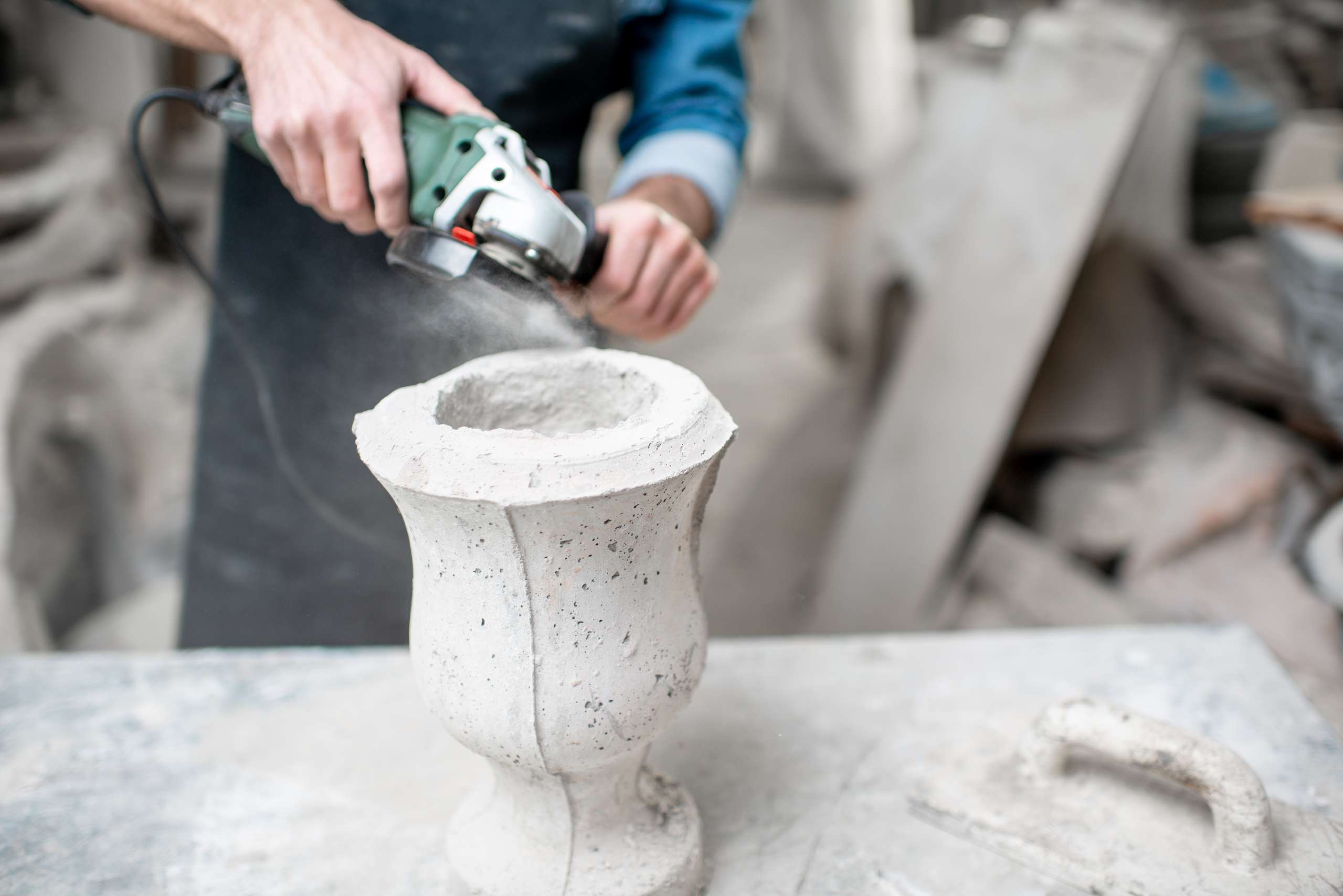
- The deliberate seam Instead of hiding where two mold parts met, some makers emphasize it with a shallow V-groove or a contrasting inlay of brass dust. The seam stops being a mistake and becomes a signature, like the visible joint on a handmade suit.
- The accepted void A single pockmark or cluster of small bubbles can be left exactly where it formed if it improves the rhythm of the surface. Viewers will read it as texture rather than damage because the rest of the piece is confident enough to carry it.
How light writes the final draft
Concrete is monochrome until light touches it. Then it reveals an entire grayscale palette. A piece photographed at noon looks flat and honest. The same piece at sunset becomes dramatic, almost bronze. Makers who understand this begin designing for specific times of day.
They orient the best face toward the window. They place voids where shadows will pool. They choose aggregate that sparkles only when the angle is low.
The object is finished twice: once in the workshop, once by the sun.
Negative space as structure
A common advanced exercise is to design an object whose primary visual element is what was removed rather than what remains. A planter with an impossibly thin wall. A lamp base that appears to float because the concrete was cast around a hidden void. A tray whose handle is nothing more than absence.
These pieces feel lighter than their weight suggests, because concrete has agreed to hold emptiness as gracefully as it holds mass.
The quiet rebellion of almost-plain
The ultimate concrete object often looks under-designed at first glance. A cylinder. A cube with softened corners. A low bowl whose only decoration is the subtle shift from satin to polished on the inner curve.
People lean in. They pick it up. They turn it. Only then do they notice the proportions are perfect, the weight is exactly where it should be, the surface changes character as they move around it.
That delayed discovery is the highest compliment concrete can receive.
It means the maker has learned to trust the material, trust the viewer, and trust silence.
When you reach that point, the workshop becomes very quiet. No more sanding for hours chasing an impossible ideal. Just the soft scrape of a mold being assembled, the low hum of the mixer, and the certainty that what comes out in forty-eight hours will not need to shout.
It will simply be there — solid, calm, and undeniably alive — speaking in a language only those who have poured, demolded, and listened for long enough can fully understand.